Llamacoids / Lamacoid FAQ
Lamacoid FAQ. The questions we get every week.
A lamacoid, also spelled lamicoid, is a laser engraved plastic ID tag. The plate has a coloured surface over a contrasting core, and the letters are cut through to the core, so there is no ink to fade or peel. Below are answers on sizes, colours, the electrical code, cost, turnaround and ordering, each linked to the full guide.
Email your tag listBuild and price a tag289-275-9572By Jake Reid, owner of Llamacoids Inc. Jake quotes every order and runs the engraving shop at 1550 Yorkton Court in Burlington. Updated 1 November 2026.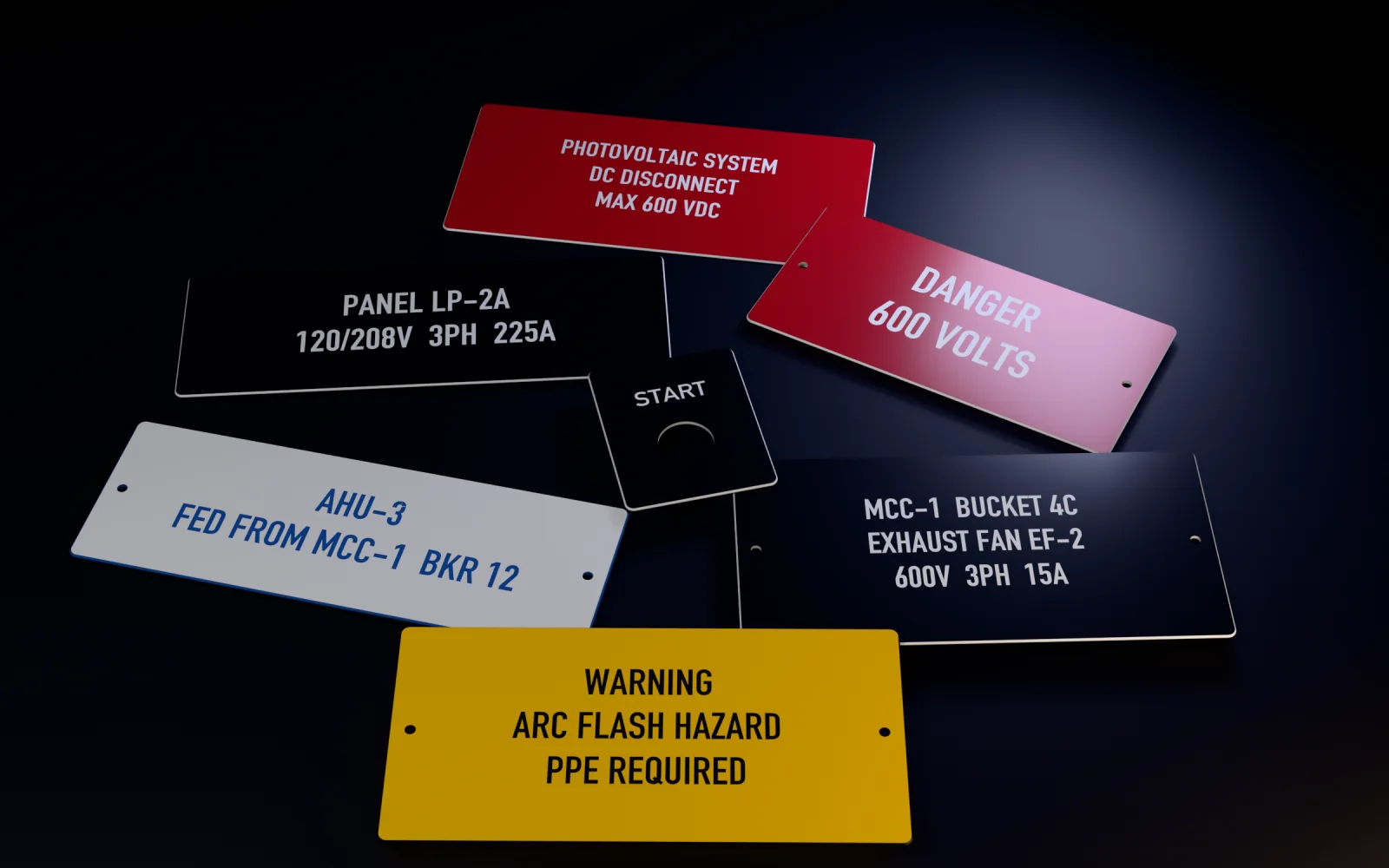
What is a lamacoid?
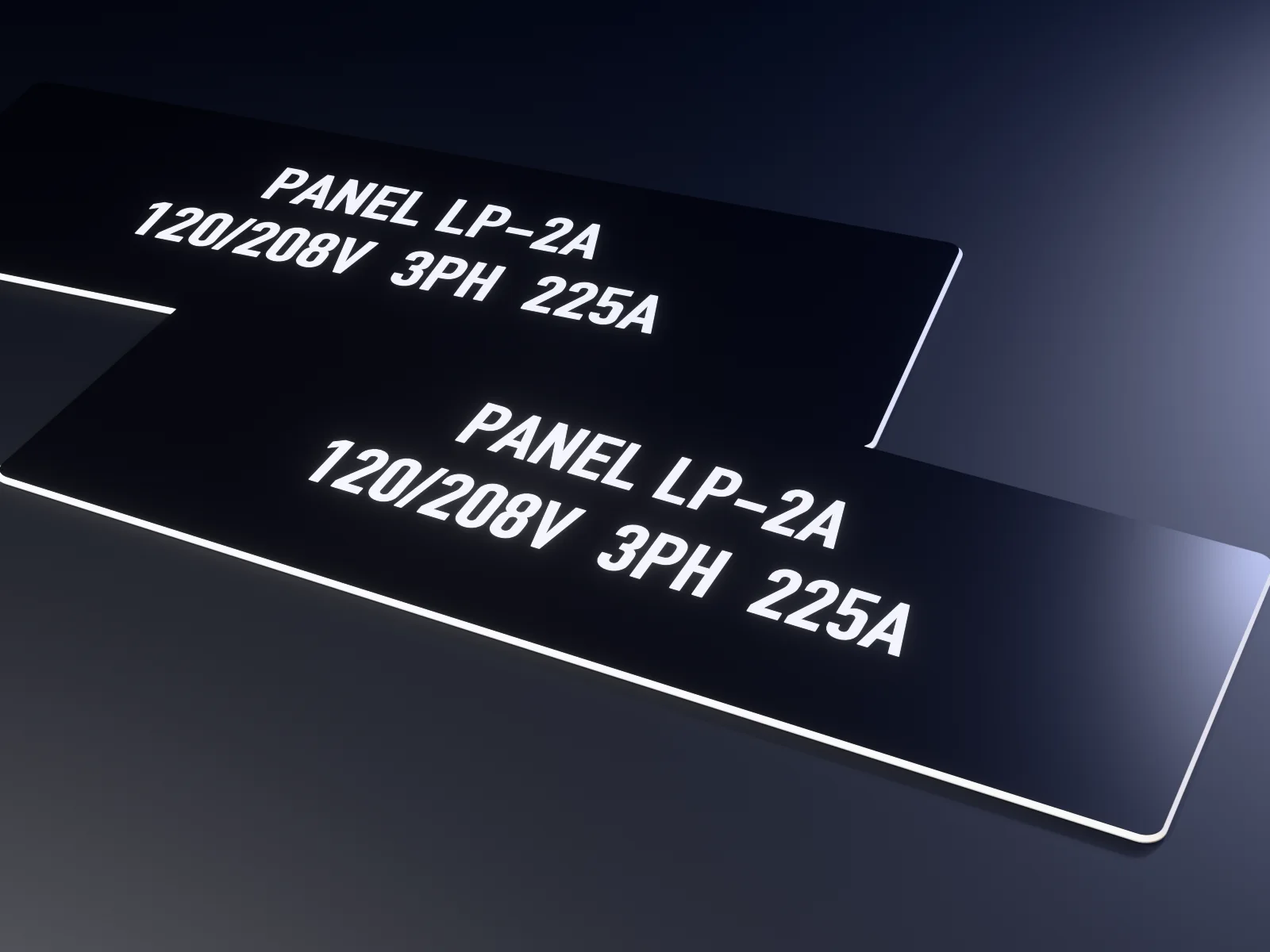
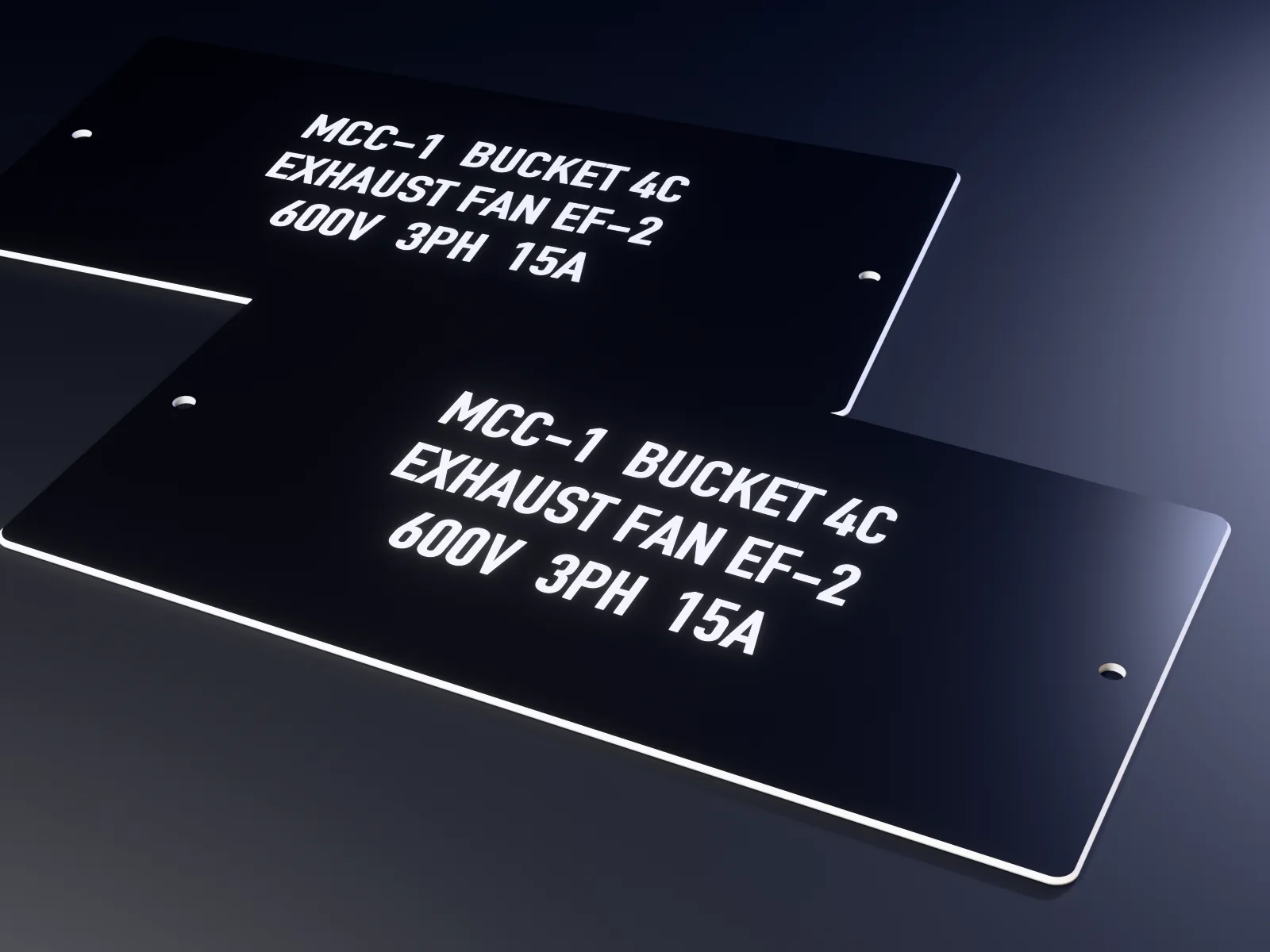
A lamacoid is an engraved identification plate cut from two-colour acrylic laminate. Engraving removes the surface colour wherever there is a letter, so the core colour forms the text. Electricians use them for panel names, breaker tags, disconnects, MCC buckets and equipment nameplates.
Is a lamacoid the same as a lamicoid?
Yes. They are two spellings of the same word for the same product. Lamacoid is more common in Ontario and English Canada; lamicoid turns up in Quebec and in supplier catalogues. In French it is a lamicoïde, usually a plaque lamicoïde. More in lamacoid or lamicoid.
What is Traffolyte?
The name used for the same kind of engraved tag in the UK and Australia. It also started as a trade name. If an older specification names Traffolyte or any other material, send the spec with your quote request and the exact grade gets confirmed rather than assumed.
Are lamacoids plastic?
Yes. A lamacoid is engraving laminate: a thin coloured cap bonded to a core of a contrasting colour. The laminate we run is acrylic-based, rigid and non-conductive.
How are lamacoids made?
On a laser engraver. Ours is a Trotec Speedy 400. A shallow pass removes the cap where the letters go, then a deeper pass cuts the outline, corners and holes, so each tag drops out of the sheet finished. See how lamacoids are made.
Why use a lamacoid instead of a printed label?
A printed label is ink on a film on a layer of glue, and each layer can let go. On a lamacoid the letters are the plate itself, so sun, solvent and abrasion have nothing to remove. That is why inspectors and plant teams accept an engraved plate where a sticker gets questioned.
What size is a lamacoid?
The most common lamacoid is 1" × 3", which holds one or two lines of 1/4" or 3/16" text. Breaker tags are usually 1/2" × 2", panel labels 2" × 4" and equipment nameplates 3" × 5". Every plate is cut to the size you give, in inches or millimetres.
How thick is a lamacoid?
1/16" (1.6 mm) is the everyday thickness for panel tags. 1/8" gives a stiffer plate for larger sizes and hanging tags.
What letter height should a panel label have?
1/4" letters read well from 2 to 3 metres, which suits most panel doors and disconnects. Breaker tags read up close use 1/8". If the spec gives a minimum height, start there.
What is the smallest lamacoid you can make?
Half an inch tall is a practical minimum for one legible line of engraving. Send the wording and the space available and the text height gets confirmed before anything is cut.
What do lamacoid colours mean?
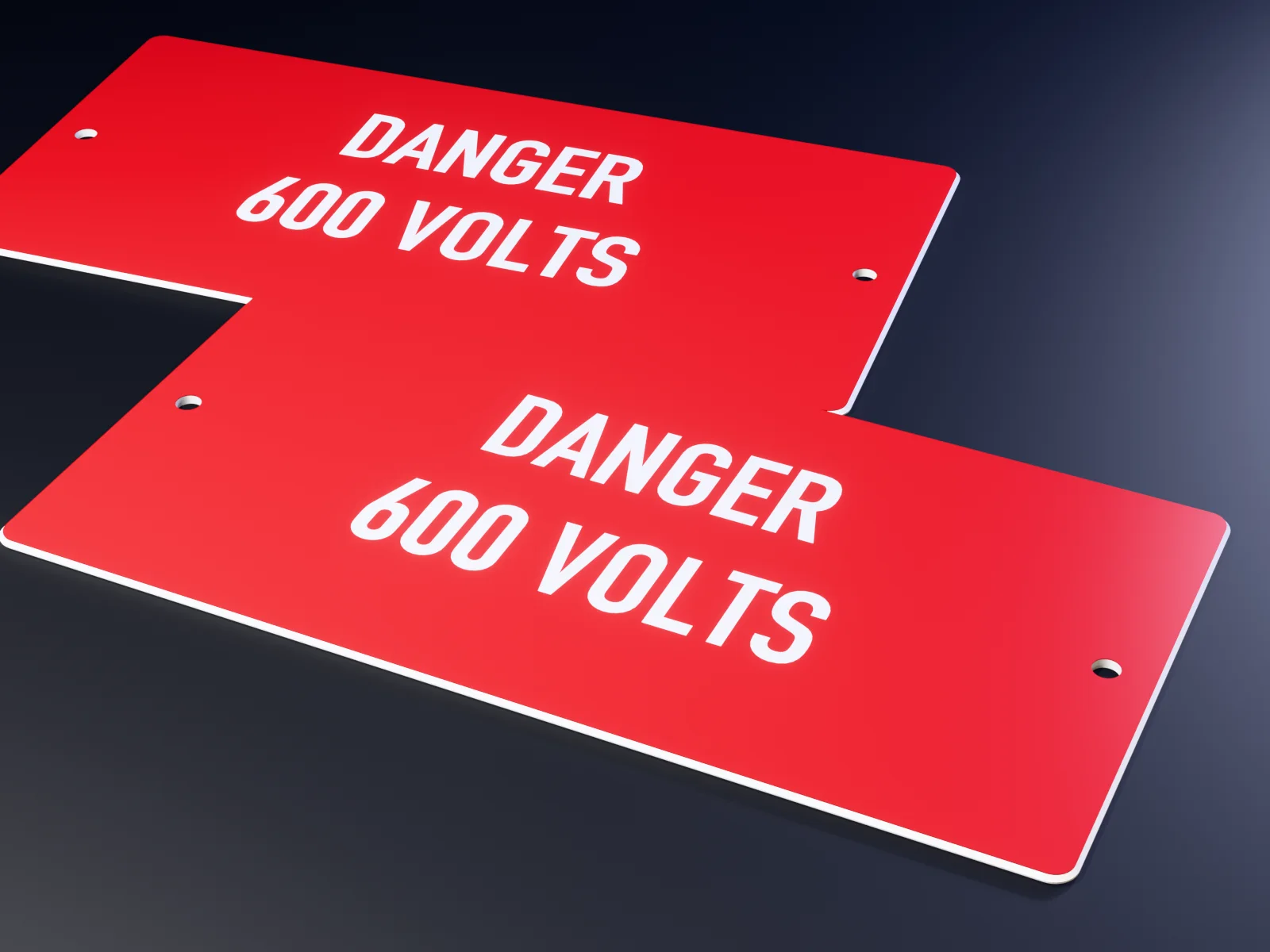
Colours are written background first, letters second, so red/white is a red plate with white letters. Black/white is the everyday choice for electrical ID. Red/white is for danger, fire and code plates such as solar PV, yellow/black for caution, and green/white for emergency and life safety circuits.
| Background / letters | Usual job |
|---|---|
| Black / white | Panels, breakers, disconnects, MCC buckets. The most-ordered pair. |
| White / black | Control stations, legend plates, dark or grey enclosures. |
| Red / white | Solar PV placards, fire protection, danger and emergency plates. |
| Yellow / black | Caution plates: second source of supply, backfed equipment, stored energy. |
| Green / white | Emergency power, life safety circuits, safe-condition equipment. |
| Blue / white | Mandatory instructions, water and process systems. |
Which colours are stocked?
Black/white, red/white, carbon/white and white/blue. Other combinations, including yellow/black caution plates, are quoted on request.
What colour should emergency power panels be?
Red/white is common. Hospitals, campuses, data centres and many owners publish their own colour standard, and when they do, that standard is the one to match.
Does the electrical code require lamacoids?
The Canadian Electrical Code (CSA C22.1) and the Ontario Electrical Safety Code ask for marking that is permanent, legible and clear about what the equipment is and does. They set the result, not the product. An engraved lamacoid meets all three, and many electrical specifications call for engraved lamicoid nameplates by name.
What is the RU4 amendment in Ontario?
An OESC change that ties circuit identification to any change in a panel. When circuits are added, removed or modified, the identification has to be done then, not only on new panels. Service calls now need permanent tags too.
What does CEC Section 64 require for solar PV?
Marking at every PV disconnect, the utility interconnection, the DC disconnect or combiner, the grounding point and, where adopted, rapid shutdown. The PV warning sign is white on red, capitals, at least 9.5 mm tall. See Section 64 solar labels.
Do arc flash labels have to follow CSA Z462?
CSA Z462 calls for equipment likely to be worked on while energized to be field-marked with an arc flash warning. The values come from your arc flash study; the plate makes them permanent. See arc flash labels.
Who is responsible for code compliance?
The installer and the responsible engineer or inspector. Llamacoids engraves plates to the wording you send and does not certify or inspect installations.
How much does a lamacoid cost?
Lamacoids are priced by plate area, so a small breaker tag costs a fraction of a large panel plate. Quantity matters too, with volume tiers at 25, 50 and 100 pieces. Tax and shipping are extra. There is no minimum order. The Lamacoid Builder shows a live price, or send your list for a line-item quote.
How long do lamacoids take?
Standard turnaround is same day. Once you approve the PDF proof, typical jobs are engraved that day in Burlington and shipped, or held for pickup at the shop. Large or complex schedules can take longer, and rush timing is available on request. Put the date you need the tags on the order.
How do I order lamacoids?
List every plate with its exact wording, size, colours, quantity and mounting, then email it to sales@llamacoids.ca or build it in the Lamacoid Builder. A spreadsheet or panel schedule is ideal. You get a line-item quote and a PDF proof to approve before anything is engraved.
How are lamacoids mounted?
Three ways: adhesive backing, drilled screw holes, or both on the same plate. Adhesive is for clean, flat, indoor surfaces. Screws or rivets are for heat, vibration, outdoor exposure and washdown. Valve tags get one hanging hole for a chain, wire or zip tie.
What size are the screw holes?
Holes are drilled to the diameter and position you give. 1/8" and 3/16" are typical for screw or rivet mounting. The builder keeps holes clear of the lettering.
Will an adhesive lamacoid stay on?
On a clean, smooth, flat indoor surface such as an enclosure door, yes. Outside, in freezers or where things get hosed down, screw it on. The adhesive is the weak point there, not the plate.
Can lamacoids be used outdoors?
Yes. Lamacoids go on rooftop units, solar equipment, EV chargers, generators and outdoor switchgear. The lettering is the core of the plate, so rain cannot lift it. Screw or rivet outdoor plates rather than relying on adhesive, use stainless or brass hardware, and say on the order that the plate goes outside.
Are lamacoids waterproof?
The lettering is, and the laminate does not soak up water. For wet locations, mount the plate with screws or rivets so the mounting holds up as well as the lettering does.
Does engraved mean outdoor-rated?
No. An engraved finish alone does not set an outdoor-life rating. Tell us where the plate is going and the material grade and mounting get confirmed for that spot.
Where are Llamacoids lamacoids made?
In our shop at 1550 Yorkton Court, Unit 7, Burlington, Ontario L7P 5B7, north of the QEW. Every plate is engraved there. Most work goes to Halton, Hamilton, Peel and Toronto, and orders ship anywhere in Canada.
Do you ship lamacoids across Canada?
Yes. Every lamacoid is engraved in Burlington, Ontario and ships by Canada Post or courier to anywhere in Canada. The builder shows Canada Post rates once you enter a postal code.
Do you serve Hamilton, Oakville and Milton?
Yes. They are all a short drive from the shop, and orders from there are engraved the same day like any other.
Do you have a Toronto location?
No. Toronto orders are engraved in Burlington, about 60 km west of downtown along the QEW, and sent by courier to the office, the site or the loading dock.
Can I pick up an order?
Yes. Choose pickup at the Burlington shop in the builder, or ask when you email the order.
Lamacoids in Burlington → · Lamacoids for Toronto and the GTA →
What do the words on a lamacoid order mean?
Most of the vocabulary is trade shorthand. These are the terms that come up on drawings, specs and quotes, with what each one means for the plate.
- Surface / core (cap / core)
- The two layers of the laminate. The surface is the background colour; the engraving exposes the core, which becomes the letters.
- 2-ply
- Laminate with one surface layer over one core. This is what panel tags are cut from.
- Legend plate
- A small plate that names a pushbutton, selector switch or pilot light. Usually sized around a 22 mm or 30 mm device.
- Nameplate
- A plate that identifies a piece of equipment: asset number, name, location, source.
- Circuit directory
- One larger plate listing each circuit number and its description, instead of separate breaker tags.
- Fed from / feeds
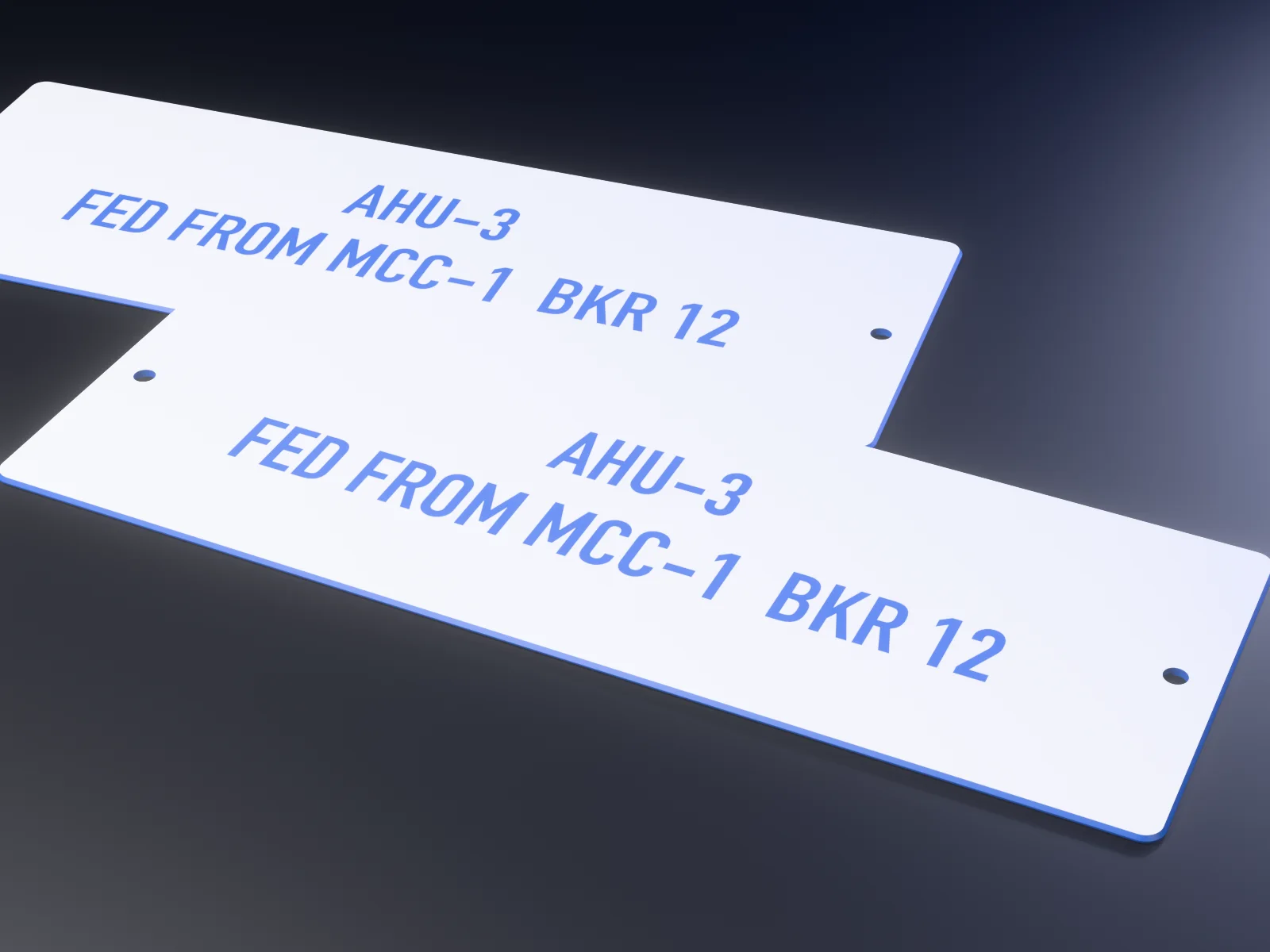
- Where a panel or disconnect gets its power, and what it supplies. Both belong on a good panel plate.
- AHJ
- Authority having jurisdiction: the inspector or body that enforces the code where you are. In Ontario that is the ESA.
- OESC
- The Ontario Electrical Safety Code, Ontario's adoption of the Canadian Electrical Code, CSA C22.1.
- Section 64
- The part of the CEC that covers renewable energy systems, including solar PV marking.
- CSA Z462
- Canada's workplace electrical safety standard. It is where arc flash labelling comes from.